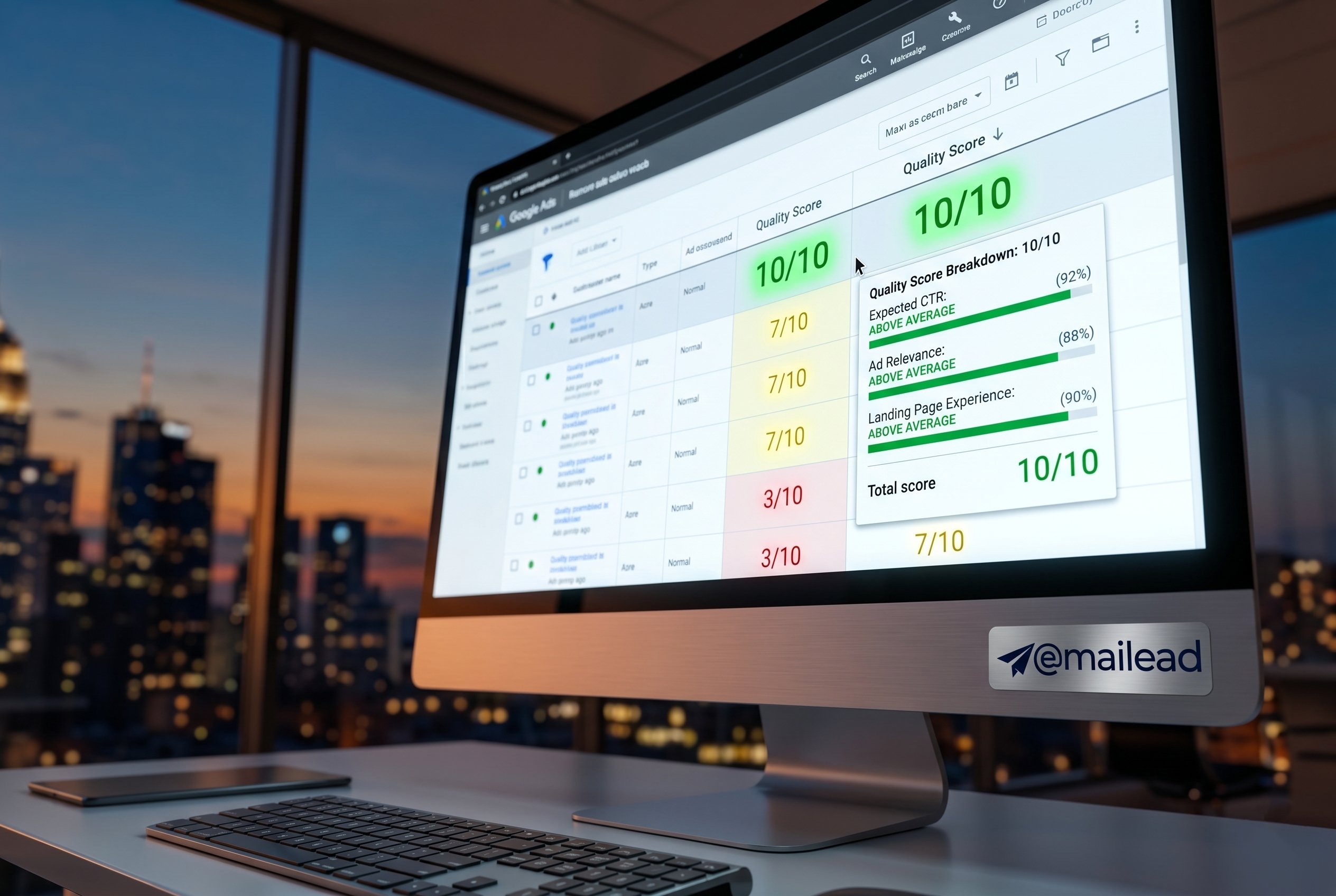
In paid search auctions, bidding the most money doesn't guarantee your ad lands in the top spot. Google determines ad rank using a combination of your bid and your **Quality Score**.
Quality Score is Google's rating of the relevance and quality of both your ads and landing pages, graded on a scale of **1 to 10**. A high Quality Score acts like an ad discount: it boosts your ad position while lowering your Cost-Per-Click (CPC). In contrast, a low Quality Score penalizes you, making you pay double to win the same traffic. In this guide, we break down how to optimize your campaign structure for maximum Quality Score.
The Three Pillars of Quality Score
Google evaluates Quality Score using three core factors. To rank high, you must optimize for all three:
1. Expected Click-Through Rate (eCTR)
Expected CTR measures how likely users are to click your ad when Google displays it. This is based on historical account data and how closely your ad copies match the search query. To optimize, write compelling headlines, use active verbs, and leverage all available **Ad Assets** (like sitelinks, callouts, and structured snippets) to expand your ad's visual size.
2. Ad Relevance
Ad Relevance measures how closely your ad matches the search query. If a user searches for "auto insurance coverage," and your ad headline reads "Insurance Agency Plans," your relevance score drops. Google wants to see the exact search phrase in your ad headlines.
3. Landing Page Experience
Google crawls your landing page to ensure it matches the user's intent. Your landing page must be fast, mobile-responsive, easy to navigate, and contain the target keywords of the ad that referred the user. If visitors leave your landing page immediately without clicking or scrolling, Google demotes your landing page experience score.
Optimizing Account Structure: The STAG Framework
The best way to raise Ad Relevance and Expected CTR is to transition from broad, cluttered ad groups to **Single Theme Ad Groups (STAGs)**. In a STAG, you limit each ad group to a single, tightly focused theme of 3 to 5 closely related keywords. For example:
- Ad Group A Theme: "Term Life Insurance" (Keywords: term life insurance, quote term life, buy term life). The ads in this group mention only "Term Life Insurance."
- Ad Group B Theme: "Whole Life Insurance" (Keywords: whole life insurance, whole life quote, cost of whole life). The ads here mention only "Whole Life Insurance."
By splitting themes into dedicated ad groups, you ensure that searchers see ads that mirror their search terms, driving up CTR and Ad Relevance scores.
A Quality Score Optimization Checklist
Run through this quick checklist to locate and fix low Quality Score ad sets:
- Identify Underperformers: Add the "Quality Score," "Ad Relevance," "eCTR," and "Landing Page Exp" columns to your Google Ads keyword dashboard. Filter for keywords scoring 5 or below.
- Inject Dynamic Keyword Insertion (DKI): Use DKI in your ad headlines (e.g., `{KeyWord:Default Headline}`) to dynamically match the user's exact search terms.
- Audit Landing Page Speeds: Run your landing pages through Google PageSpeed Insights. Compress images, reduce heavy scripts, and aim for mobile load times under 2.5 seconds.
- Ensure Copy Alignment: Make sure the main headline of your landing page matches the target keywords of your ad group. If your ad group targets "commercial window cleaning," your landing page header should read "Commercial Window Cleaning Services."
Conclusion: Reaping the Rewards of Quality
Raising your Google Ads Quality Score is the single most effective way to optimize your ad spend. By structuring campaigns into Single Theme Ad Groups (STAGs), writing highly aligned ad copy, and optimizing landing page speeds, you win higher ad positions, pay less per click, and raise your campaign ROAS. Audit your Quality Scores this week, locate the bottlenecks, and restructure for maximum returns.